
Repurpose one product idea into social assets
Turn one approved product idea into coordinated image, video, caption, and audio assets in an Infiknit canvas for repeatable campaigns.
 Nia OkaforUGC & Social Editor
Repurposing is not copying the same asset into every format. The idea stays stable while the proof, pacing, crop, and caption change for each surface. Keep the original product idea as the source and make each output a deliberate branch.
Short answer: Write the product idea, proof, and next action once. Keep that source branch unchanged, then create one branch for each format: a still, a demonstration clip, a caption-led post, or an audio-supported cut. Give every branch its own job, crop, pacing, and review condition. Export only the versions that preserve the product and evidence clearly on their intended surface.
Which product idea is worth repurposing?
Choose an idea with one visible action or observation. “Show the bottle's one-handed cap” can support a still detail, a demonstration clip, a caption-led explanation, and a short audio cut. “Promote the bottle everywhere” has no stable proof, so each branch would invent a different message. Write the fixed product fact and the viewer's next action before opening the format branches.
Define the source idea
Write the product, audience problem, proof, and next action in four lines. Add the approved product image or reference media. Then list the outputs you actually need: a still, a short demo, a vertical cut, a caption-led variation, or an audio-supported version.
Create format-specific branches
The still should communicate the product at a glance. The short video should demonstrate one action. The caption-led version should make the viewer understand the context without sound. The audio-supported version should add meaning, not merely fill silence. Connect each branch to the same source brief so the relationship remains visible.
Review the outputs together for identity and claims. A variation can change framing and energy while keeping the product, promise, and evidence aligned. Save the approved versions with the source idea and the reason each format exists.
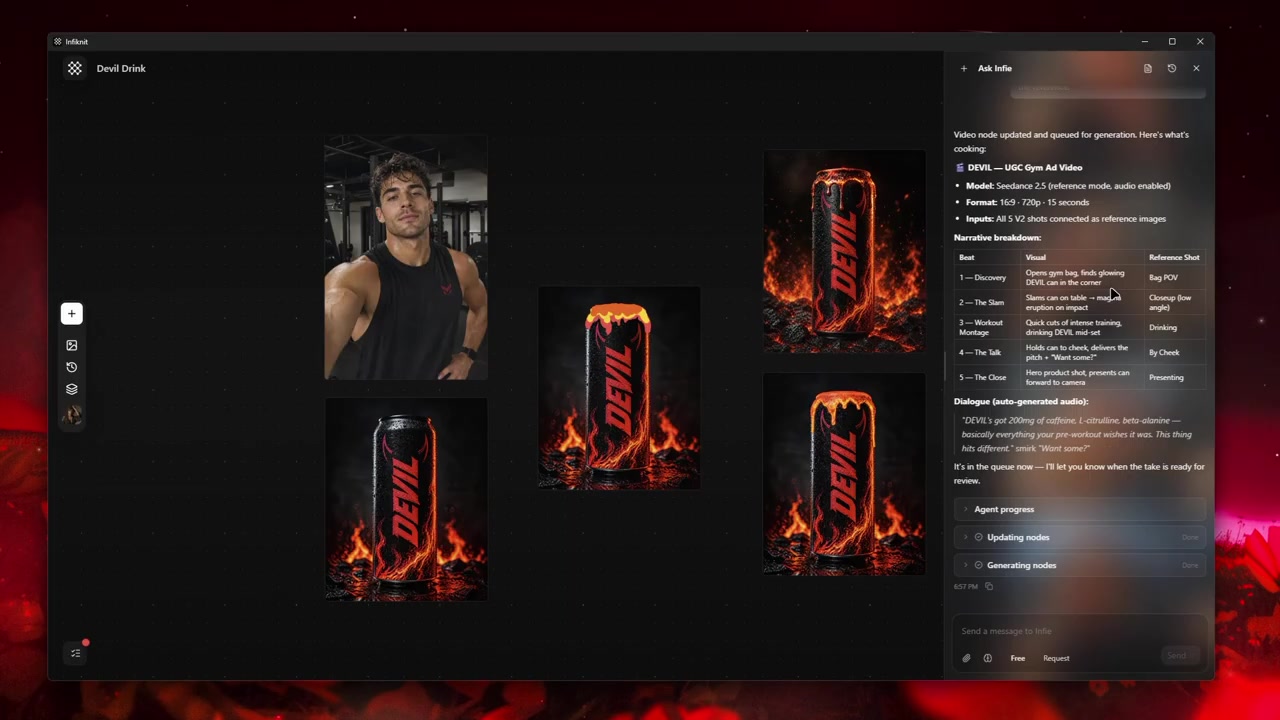
Example of keeping the source and candidate decisions together before adapting a format.
Choose the source idea carefully
Repurposing is easiest when the source idea is narrow. “Show the new bottle’s one-handed cap” can become a still detail, a demonstration clip, a caption-led explanation, and a creator reaction. “Promote the product everywhere” cannot guide a useful branch. Write the one action or observation that gives the idea its identity.
Keep the approved source media and any product facts in the same project. If the product has multiple views, label which view supports which output. A vertical video may need a different crop from a still, but it should not silently use a different product version.
Adapt the message to the surface
An image has one glance to establish the subject. A video can reveal the action over time. A caption can supply context when the viewer has no sound. An audio track can add warmth or instruction, but it should not carry a claim the visual cannot support. Treat each output as its own communication problem.
Review the set as a family. The outputs should feel related without being identical. Compare the product, promise, and next action across every branch. If one asset drifts, correct that asset rather than changing the source idea to accommodate it.
Preserve reuse evidence
Save the brief, approved reference, chosen output, and the decision that made each branch useful. You do not need to keep every experiment forever. Keep enough context for another creator to understand what the idea was and how the format changed it.
A handoff between creative roles
The writer owns the source idea and the words. The visual creator owns the reference, framing, and generated candidates. The editor owns pacing, captions, and the final format. The reviewer owns product accuracy, claims, permissions, and disclosure. Keeping these responsibilities visible prevents a platform crop from changing the source idea or a polished edit from hiding a product error.
When a handoff happens, include the source branch, not only the export. A file name can identify an asset, but it cannot explain which reference was used or why a particular crop was chosen. The connected canvas gives the next person a short route back to that evidence.
Decide when to stop
Stop repurposing when the next format would remove the proof, repeat an existing asset, or introduce a new claim. Make a new brief when the viewer question changes. For example, a product demonstration and a product-explanation post may use the same image but need different evidence and review. Keeping them as separate briefs is clearer than forcing both into one asset family.
A disciplined stop protects the library from the same repetition that makes weak content feel large. One strong idea, adapted with intention, is enough. The canvas should make that choice visible.
Example: one feature, four deliverables
Suppose the source idea is a travel mug with a one-handed lid. The still can show the lid and the hand position in one clear frame. The short video can demonstrate opening and closing it while walking. The caption-led version can explain the situation for a viewer watching without sound. The audio-supported version can use a short spoken explanation while the video shows the mechanism. All four assets share the same product reference and fact note, but each has a different job.
The still should not try to tell the whole story. The video should not depend on a tiny label. The caption should not make a claim that the product image cannot support. The audio should not add a promise about durability unless that promise is approved. Repurposing is successful when each format becomes clearer, not when every format contains every detail.
Keep a source-of-truth branch
Create one branch that contains the approved product image, the short source brief, and the fact note. Do not edit that branch for a platform-specific crop or caption. Create a child branch for each format instead. If the product packaging changes later, update the source-of-truth branch first, then review which descendants are affected.
This structure also makes collaboration easier. A writer can revise the caption branch without replacing the product reference. A video editor can trim the demonstration without losing the original shot. A reviewer can compare the branches and see whether the same idea survived the adaptation.
Avoid low-value repurposing
Not every output deserves a page or a separate export. If two variations answer the same viewer question in the same format, keep the stronger one and retire the duplicate. If a format cannot show the product accurately, change the concept or remove that deliverable. More files do not create more content value.
Review the final set for balance: one asset that explains, one that demonstrates, and one that gives the viewer a next step is often more useful than ten near-identical crops. Record the reason each asset exists so future work begins with a decision rather than a blank canvas.
A final consistency check
Read the source idea once, then review every output without looking at its filename. Can a new reviewer identify the same product and promise in each format? If not, repair the branch or retire it. This check catches drift that can be missed when every asset is reviewed in isolation.
If the set passes, export only the formats that have a clear destination and owner. An asset without a use, reviewer, or format requirement is an experiment, not a deliverable. Keep experiments in the project until the decision is clear, then archive or retire them so the publication library stays understandable.
The same rule applies to captions and audio. A caption that works on one surface may be too long on another, and a voice track may need a different pause for a shorter cut. Adapt the delivery while keeping the source idea, product facts, and proof aligned.
This keeps repurposing focused on communication rather than volume. Each output earns its place by making the original idea easier to understand in its intended context.
Archive the rest with a short reason so future work does not recreate the same duplicate set. When a platform changes its aspect ratio or caption limits, update only the affected child branch and leave the source branch untouched. Compare the new output with the earlier version to confirm that the product and promise survived the adaptation.
Use the source branch as the authority at every handoff. A caption edit should not replace the product reference, a new crop should not erase the original proof, and an audio adjustment should not change the claim. This keeps the asset family small enough to inspect while still making each format useful on its own surface.
What should be recorded for each branch?
Save the source version, target surface, fixed product fact, format-specific change, selected output, and review decision. For video, include the proof frame, duration, crop, and caption or audio state. For a still, include the intended placement and text-safe area. A new creator should be able to identify the branch's job without opening every export in the project.
When should repurposing stop?
Stop when the next format repeats an existing viewer question, removes the proof, or requires a new product claim. Start a new brief when the idea changes from demonstration to a different promise. That stop rule prevents a connected canvas from becoming a pile of near-identical versions and leaves the team with a clear source for the next campaign.
Give every adaptation one sentence that states its job before work begins. A six-second vertical clip might earn attention, a product close-up might establish the proof, and a square image might support a saved post. When each output has a distinct job, the team can adapt a source idea without making a batch of nearly identical assets. It also makes campaign review concrete: approve the format that solves its intended communication problem and retire the rest.