
UGC ad hooks and creative variations
Build controlled UGC ad-hook variations around one approved proof moment while preserving the creative record for repeatable testing.
 Nia OkaforUGC & Social Editor
An ad hook is not a bag of opening lines. It is a testable promise about what the viewer will see next. When a product demo is already approved, the most useful variations change the opening while leaving the proof moment, product, and claim stable. That makes the comparison interpretable.
Short answer: Choose one approved proof shot, write three genuinely different opening ideas, change one variable at a time, and keep each branch connected to the same source material. A winning hook is useful only if the team can explain what was different and what was held constant.
Which hook deserves a branch?
Give a branch to an opening only when it changes the viewer's first question. “Watch the cap close” creates a demonstration expectation; “Will this fit in my bag?” creates a context expectation. Both can use the same approved proof, but they should not be mixed with a new product source or claim in the same test. If two openings lead to the same first frame and same viewer question, keep the clearer one and use the saved branch for a different decision.
Use the canvas for the part a creative team can control: the source, hook, proof moment, version notes, and review decision. Keep delivery and performance results in the campaign record so a creative branch is never mistaken for a platform report.
Start with the proof, then earn attention
The opening has to lead somewhere. A product can be introduced with a problem, an unexpected demonstration, a direct opinion, or a visible comparison, but the next shot should verify the opening's implication. If the hook says the product is easy to pack, show the packing action. If it says “watch this,” show the specific detail worth watching.
An Infiknit UGC project provides a useful example of this production order. The project first establishes a pre-workout can and selected product frames, then turns those frames into video. It does not start with dozens of voiceover lines. Read the full UGC product-video case study for the image and video decisions; do not reuse that case study as generic ad copy.
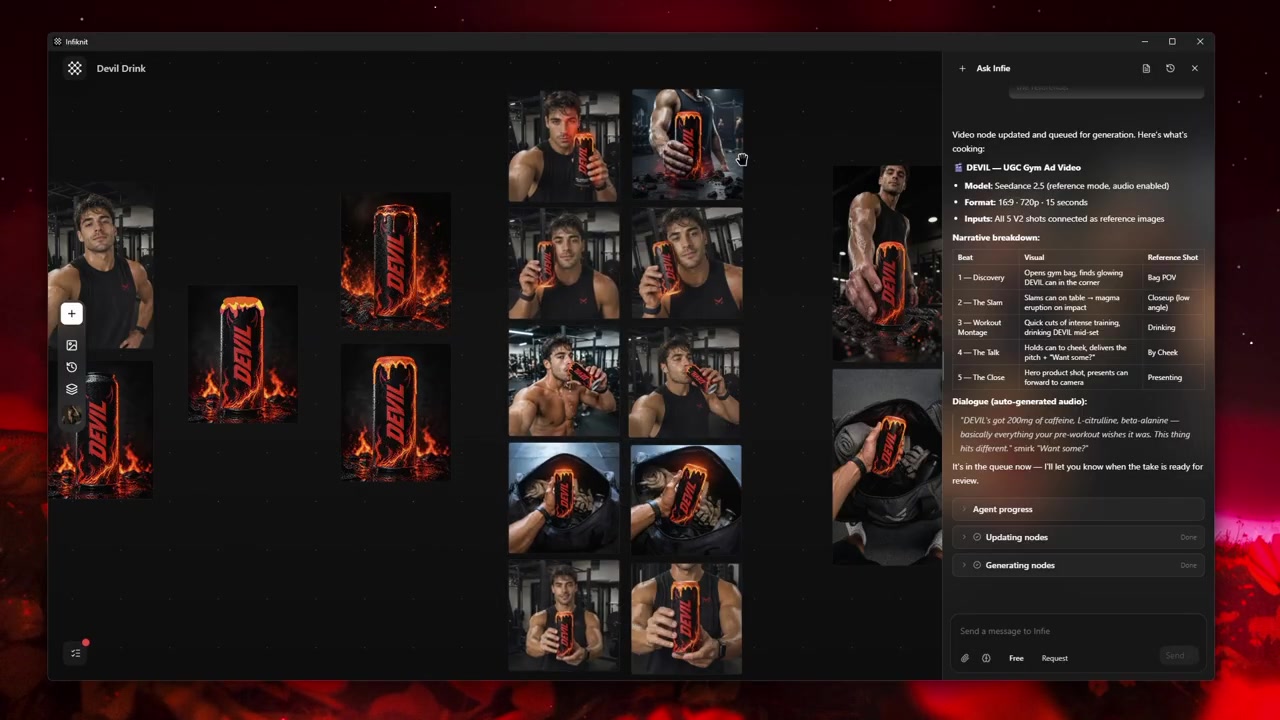
The proof source is selected before the opening variation is tested.
Before you write any hook, complete this sentence: “By the end of the first three seconds, the viewer should understand ___, and the next shot proves it by ___.” If the second blank is vague, the hook is premature.
Separate a concept from a claim
There are two kinds of hooks, and confusing them causes avoidable review failures.
- A concept hook creates curiosity: “I did not expect this to fit in here.”
- A product claim says something factual: “This holds 24 hours of charge.”
Concept hooks can be explored creatively as long as they do not imply a fact the product cannot support. Product claims belong in the approved claim sheet and need a visible proof or source note that matches the wording. Keep the claim as a fixed input while the opening changes; otherwise the test cannot show whether the hook or the new statement caused the result.
Put the claim sheet in its own canvas node. The creative branch can pull from it, but cannot silently rewrite it. This makes legal or brand review much faster when a hook changes halfway through production.
Create three opening families
Three opening families give you variation without making the test incoherent. Pick one proof moment and write an opening for each family.
| Opening family | What it does | Example structure | Keep fixed |
|---|---|---|---|
| Direct demonstration | shows the product immediately | “Watch the cap close” → cap action | product, proof shot, claim |
| Problem recognition | names a real friction before the proof | “I kept spilling this in my bag” → packing action | product, proof shot, claim |
| Specific curiosity | asks the viewer to notice a detail | “The part I would check first is this” → detail close-up | product, proof shot, claim |
Keep a creator-style voice as a presentation treatment and write the source of the product evidence beside it. A hook can sound conversational without changing the underlying product proof. When a recorded project is the reference, link the source frame and retain the same product and action in every opening branch.
Build branches that remain comparable
Name a branch by the question it answers, not by an arbitrary version number. “Problem opening / bag proof / vertical” is useful six weeks later. “V8-final-real” is not.
For a clean first pass, hold these constants:
- the exact product source;
- the approved proof shot or proof action;
- the target placement and crop;
- the factual claim, if there is one;
- the closing action.
Then change one opening variable: spoken line, first frame, camera distance, on-screen text, or the order in which the product appears. If a new version changes the product, the setting, the creator, the hook, and the proof at the same time, it is a new concept—not a variation. Keep it in a separate group.
For a sequence-level plan, use storyboard UGC video before generation. For prompt and reference control while producing the selected branch, use create a UGC product demo from a product image.
Review an opening at the delivery size
An opening that works on a large canvas can fail in the placement where people actually see it. Review each candidate muted, at the intended crop, and after the caption is applied. Ask:
- What is the product in the first moment?
- What does the viewer expect to learn or see next?
- Is the proof visible quickly enough?
- Is the claim understandable and defensible?
- Could the first frame be mistaken for an endorsement, discount, or feature that is not true?
If the hook needs a long explanation before the product appears, shorten it. If it needs a special effect to hide an unclear product action, return to the proof shot. A polished opening does not compensate for a weak or misleading demonstration.
Use Infiknit as the record of creative decisions
The canvas is valuable here because it keeps a variation's sources visible. Connect the approved product reference, hook line, proof shot, caption, and review note to the same branch. A teammate should be able to open the branch and understand why the variation exists without reconstructing it from exported filenames.
This is especially useful when a strong still needs a new video treatment. Create AI video from reference images explains how to preserve an approved frame as the motion source. If the product needs a more controlled visual system before ads are made, start with building an AI brand visual consistency system.
Learn after delivery without rewriting history
Performance data is not a property of the canvas. Pull it from the platform and campaign measurement that delivered the asset. Store the result beside the variation with enough context to interpret it: placement, audience, spend or distribution condition, dates, and the exact creative version.
Do not declare a hook “the winner” merely because a single post received more views. Creative distribution, audience, timing, spend, and placement can all differ. The responsible conclusion is narrower: under these recorded conditions, this opening produced this result. That still gives the next production round a useful hypothesis.
A compact variation brief
Use this brief for each hook before production:
| Field | Example |
|---|---|
| Viewer tension | “Will this leak in my bag?” |
| Approved proof | bottle closes and is placed in bag |
| Fixed product fact | leak-resistant lid, if approved |
| Opening variable | question on screen |
| Delivery context | vertical paid social placement |
| Reject if | lid or product shape changes; claim is not supported |
The brief is intentionally small. It creates room for creative judgment while preserving the information needed for a fair comparison.
Read the creative record before making the next round
A variation only becomes learning when the record is complete enough to challenge it. Save the actual first frame, on-screen text, proof shot, caption, format, and delivery context with the result. Then ask a narrow question: did the direct demonstration create a clearer expectation than the problem opening for this placement and audience? Avoid claims that a creative “works” in general from one delivery condition.
This discipline is also useful before anything is published. A reviewer can trace an opening back to an approved product source, see whether a new statement appeared in the caption, and identify whether the visual proof genuinely follows the hook. It prevents the common failure in which a later editor inherits a “winner” but cannot tell whether the result came from the opening, the audience, budget, timing, or a different product presentation.
For the broader campaign record, connect this branch to AI visual content creation for marketing campaigns. For production details before the proof exists, use creating consistent AI product photography and turning product images into AI product videos. Confirm the destination's current format and ad requirements at delivery time; keep those settings in the branch rather than copying them into every hook note.
The same record makes a practical stop rule possible: stop expanding a variation set when the next change does not answer a new creative question. More options are not more evidence when all of them change the same thing.
How many UGC hooks should be tested together?
Three openings are enough for a first comparison when the proof, product source, format, and claim stay fixed. Add a fourth only if it tests a new viewer question or frame treatment. Review each candidate muted at the intended crop, then compare the exact first frame and proof arrival. Keep the accepted opening and the reason it passed; preserve a rejected branch only when its failure teaches the next round what to change.